Woman Praying in a Mosque: A Versatile Vector Resource for Designers and Communicators
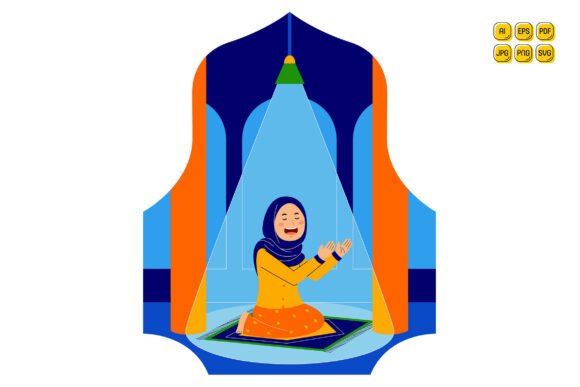
A Woman Praying in a Mosque vector illustration is a digitally crafted, scalable graphic depicting a respectful, culturally grounded scene of Islamic worship. Rendered in flat design style, it emphasizes clarity, modesty, and spiritual serenity—avoiding realism or stylization that could misrepresent religious practice. These illustrations are not photographs or AI-generated imagery; they are hand-crafted vector assets built with precision, intended for professional reuse across digital and print contexts.
Designers, educators, faith-based organizations, and content creators may seek such an illustration for specific communicative goals: to visually affirm inclusivity in multicultural campaigns, support interfaith educational materials, enhance website accessibility through symbolic representation, or reinforce cultural sensitivity in public-facing resources. The image’s value lies less in aesthetic novelty and more in its functional reliability—its ability to convey reverence, intentionality, and context without ambiguity.
Why This Illustration Supports Practical Design Workflows
The included file formats—AI, EPS, SVG, PDF, JPG, and PNG—ensure compatibility across common design environments. Adobe Illustrator users retain full layer control and path editing capability; SVG files integrate cleanly into web development pipelines; PNGs with transparent backgrounds allow flexible compositing over varied layouts; and the 5000 × 5000 pixel resolution supports high-fidelity output from social media thumbnails to large-format banners.
Each shape within the illustration is individually selectable and editable. That means color palettes can be adjusted to match brand guidelines—soft blues for calm institutional messaging, warm golds for celebratory announcements, or monochrome tones for minimalist interfaces. Scaling introduces no quality loss, eliminating the need for separate assets at different sizes. Elements like the prayer mat, architectural arches, or the figure’s posture can also be isolated, repositioned, or combined with other vectors (e.g., mosque silhouettes, calligraphy motifs, or seasonal icons) to build custom scenes without redrawing from scratch.
Key Benefits and Realistic Considerations
Benefits:
- Time efficiency: Reduces hours spent sourcing, licensing, or commissioning bespoke religious imagery.
- Consistency: Enables uniform visual language across multiple platforms—landing pages, infographics, internal training decks, or printed brochures.
- Cultural alignment: Offers a respectful, non-stereotypical depiction aligned with common conventions of modesty and spatial orientation in Islamic prayer.
- Adaptability: Works equally well in secular educational contexts (e.g., world religions curricula) and faith-affirming outreach (e.g., mosque welcome materials).
Tradeoffs and expectations:
Vector illustrations like Woman Praying in a Mosque prioritize clarity and editability over photorealism. They do not depict specific ethnicities, facial features, or regional architectural details—intentionally avoiding assumptions about identity or geography. Users seeking highly contextualized visuals (e.g., a woman praying in a Turkish mosque with Ottoman tilework, or a Southeast Asian setting with local dress) will need to supplement the base asset with additional research or custom adaptation. Similarly, while colors and shapes are fully editable, the underlying composition—including pose, gesture, and spatial relationships—is fixed. Significant compositional changes (e.g., converting a frontal view to a profile, or adding multiple figures) require intermediate vector skills.
When This Resource Fits Well
This collection is especially useful when your goal involves clear, repeatable communication—not storytelling or documentary representation. It fits strongly in scenarios such as:
- Developing multilingual health or civic information kits where visual cues must transcend language barriers.
- Building responsive websites or apps serving diverse Muslim communities, where inclusive iconography supports user trust.
- Creating internal training materials for service providers (e.g., healthcare staff, educators) on cultural humility and religious accommodation.
- Designing social media campaigns around themes like Ramadan, spiritual wellness, or interfaith dialogue—where consistent, respectful imagery reinforces message integrity.
In these cases, the ability to rapidly adapt one reliable base illustration saves time without compromising dignity or accuracy.
When Alternatives May Be More Appropriate
Consider alternatives if your project demands:
- Specific cultural or regional authenticity: For projects centered on a particular community—such as a local mosque’s anniversary booklet or a regional interfaith festival—the generic nature of a flat-design vector may feel too generalized. Commissioned photography or custom illustration better captures localized nuance.
- Narrative or emotional complexity: If the goal is to evoke personal reflection, historical context, or individual experience (e.g., “a young woman praying for the first time after conversion”), a static vector may lack the expressive depth needed. Illustrated storyboards or carefully curated stock photography may serve better.
- Legal or compliance requirements: Some institutions mandate documented model releases or provenance for all human depictions—even symbolic ones. While vector illustrations typically avoid this requirement, verify organizational policy before deployment in regulated sectors like government or higher education.
Making an Informed Choice
Before selecting Woman Praying in a Mosque assets, clarify your core objective: Are you aiming for functional consistency or expressive specificity? If the former dominates—if speed, scalability, and respectful neutrality matter most—this vector set delivers measurable utility. Review the included files to confirm format compatibility with your team’s tools. Test basic edits (e.g., recoloring the prayer mat or isolating the figure) to assess comfort with the layer structure.
Also consider audience perception. In some contexts, even abstracted religious imagery benefits from consultation with community representatives—especially when used externally. A brief review by a local imam, educator, or diversity officer can help ensure alignment with shared values of respect and accuracy.
Finally, evaluate long-term needs. If your organization regularly produces faith-inclusive content, investing in a broader set of culturally grounded vectors—covering diverse ages, abilities, and settings—may yield greater return than a single illustration. But for targeted, immediate use, a well-executed Woman Praying in a Mosque vector offers a balanced blend of practicality, ethics, and design flexibility.