Ramadan Calendar with Woman Pencil: A Versatile Visual Resource for Meaningful Design
Visual communication during Ramadan carries unique cultural, spiritual, and emotional weight. A well-crafted illustration doesn’t just decorate—it conveys reverence, intentionality, and communal resonance. The Ramadan Calendar with Woman Pencil stands apart not as a static image, but as a foundational design system—engineered for flexibility, clarity, and contextual relevance across diverse professional and creative domains.
Why Flat Vector Design Matters in Religious and Cultural Contexts
Flat design isn’t merely an aesthetic choice—it’s a functional necessity when representing sacred timeframes like Ramadan. Its clean lines, uncluttered composition, and intentional use of negative space support legibility at any scale, from a mobile notification banner to a printed mosque bulletin board. Unlike photorealistic or heavily textured assets, flat vectors avoid unintended symbolism, cultural missteps, or visual noise that could dilute the solemnity of the season.
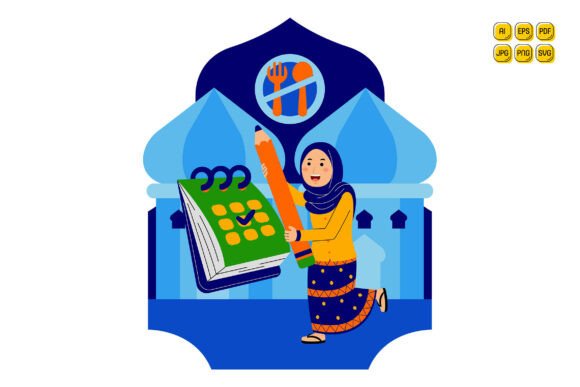
The Ramadan Calendar with Woman Pencil embraces this principle rigorously. Each element—whether the crescent moon motif, the open notebook beside a seated woman sketching thoughtfully, or the numbered grid representing days of fasting—is constructed with geometric precision and semantic clarity. There are no ambiguous shadows, no decorative flourishes that compete for attention. Instead, every shape serves dual purposes: visual recognition and editable utility.
Adaptability Across Real-World Use Cases
Designers, educators, marketers, and community organizers rarely work in isolation. Their needs shift depending on audience, platform, and objective—and the Ramadan Calendar with Woman Pencil responds fluidly.
- Social Media Campaigns: A single SVG file can be animated subtly—perhaps the pencil tip moving across the page, or dates lighting up sequentially—to create engaging Instagram carousels or WhatsApp status updates. With transparent PNG support, overlays integrate cleanly onto photo backgrounds featuring iftar gatherings or mosque architecture.
- Educational Materials: Teachers preparing Ramadan-themed lesson plans can isolate the calendar grid, recolor individual cells using Illustrator’s Live Paint Bucket, and annotate them with hadith references, dua prompts, or reflection questions. The woman figure—depicted respectfully in modest attire and focused posture—models contemplative practice without stereotyping.
- Business Branding & Retail: Halal-certified food brands, Islamic apparel labels, or wellness startups can embed the pencil icon into loyalty program visuals, packaging inserts, or limited-edition gift boxes. Changing the pencil’s color to match brand guidelines (e.g., emerald green for sustainability-focused initiatives) maintains visual cohesion while honoring seasonal significance.
- Website & Landing Pages: At 5000 × 5000 pixels, the high-resolution JPG and PDF files render crisply on retina displays. Developers can serve the SVG inline for fast-loading hero sections—ensuring the calendar remains sharp whether viewed on a smartphone in Jakarta or a desktop in Toronto.
- Printed Community Resources: Mosques and Islamic centers often distribute physical calendars ahead of Ramadan. The EPS and AI files allow local designers to add bilingual date listings (Gregorian + Hijri), QR codes linking to prayer timetables, or custom footnotes—without compromising line integrity or alignment.
Technical Flexibility That Empowers Non-Designers
Not every user is a seasoned vector artist—but every user benefits from structured editability. The Ramadan Calendar with Woman Pencil delivers this through deliberate layer organization and naming conventions. In Adobe Illustrator, layers are grouped intuitively: “Calendar_Grid”, “Woman_Figure”, “Pencil_Icon”, “Crescent_Decor”, and “Text_Placeholders”. Each shape is ungrouped by default, meaning users can select and recolor individual components—like turning the notebook’s cover teal while keeping the pencil graphite gray—without affecting surrounding elements.
This modularity extends beyond color. Because all illustrations are built using paths—not raster brushes or embedded images—resizing preserves crispness at any dimension. Scaling the entire composition to fit a 4×6 ft event banner introduces no pixelation or edge blurring. Likewise, exporting a cropped section—say, just the woman holding the pencil—for use as a profile avatar requires only three clicks, not hours of redrawing.
Combining Elements for Custom Narratives
One of the most underutilized strengths of vector libraries is compositional experimentation. Rather than treating each illustration as a finished product, the Ramadan Calendar with Woman Pencil invites synthesis. For example:
- A mental health nonprofit might pair the woman figure with a speech bubble containing “My Iftar Intention” and overlay it on a gradient background symbolizing dawn-to-dusk transitions.
- An Arabic language app developer could extract the crescent and calendar numbers, rotate them into a circular layout, and animate them as an interactive Hijri date wheel.
- A university’s interfaith office may combine the pencil with abstract watercolor textures (imported separately) to signal creativity and reflection—while retaining full vector control over core symbolic elements.
Such combinations remain scalable, print-ready, and accessible—unlike collage-based alternatives that degrade with repeated edits.
Accessibility and Inclusive Representation
Representation matters—not as decoration, but as affirmation. The woman in the Ramadan Calendar with Woman Pencil is intentionally rendered with nuanced detail: her posture suggests quiet focus rather than performance; her clothing aligns with diverse interpretations of modesty without prescribing a singular style; her expression is gentle and engaged, avoiding both stern solemnity and superficial cheerfulness. She holds a pencil—not a smartphone or tablet—emphasizing intentionality, documentation, and personal growth over passive consumption.
This subtlety supports inclusive design practices. Educators working with neurodiverse learners appreciate the absence of visual overload. Multilingual communities benefit from iconography that transcends text reliance—making the calendar effective even before translation. And because all files include transparent PNG variants, designers can place the illustration against high-contrast backgrounds for improved readability among users with low vision.
Workflow Integration for Teams and Solo Practitioners
Whether you’re a solo content creator managing ten client accounts or part of a marketing team coordinating across six countries, consistency accelerates production. The bundled file formats ensure compatibility across tools and skill levels:
- AI and EPS files serve professional designers who need precise path manipulation, global color swatches, or CMYK export for offset printing.
- SVG files enable front-end developers to embed responsive icons directly into HTML—reducing HTTP requests and improving Core Web Vitals scores.
- JPG and PNG exports let project managers, teachers, or volunteers drop assets into Canva, PowerPoint, or Google Slides without installing specialized software.
- PDF previews provide stakeholders with accurate color and layout representation—no font substitution surprises or missing layers.
This interoperability shortens feedback loops. A client reviewing a landing page mockup can request “make the pencil gold instead of navy”—and the designer implements it in under a minute, not a redesign cycle.
Long-Term Value Beyond a Single Ramadan
Seasonal assets often become obsolete after Eid—but the Ramadan Calendar with Woman Pencil resists obsolescence through abstraction and extensibility. The core visual language—hand-drawn authenticity, measured geometry, respectful symbolism—translates naturally to other observances: Shawwal planning, Hajj preparation guides, or Qur’an memorization trackers. By adjusting colors, swapping icons (e.g., replacing the crescent with a Kaaba silhouette), or repositioning the woman figure beside a digital tablet instead of paper, the same base asset evolves meaningfully.
Moreover, its flat design style ensures longevity. Unlike trend-dependent aesthetics—gradients, glassmorphism, or 3D renders—the minimalist vector approach avoids dating itself. A calendar designed in 2024 will retain visual authority in 2028, requiring only minor updates to typography or layout spacing.
Practical Considerations Before Implementation
While the technical advantages are clear, thoughtful deployment requires awareness of context. Always verify cultural appropriateness with local stakeholders—especially when adapting the woman figure for regional audiences where gesture, gaze direction, or garment details carry specific meaning. Test color contrasts against accessibility standards (WCAG AA minimum) if used in digital interfaces. And remember: even the most versatile asset gains power through restraint. Over-combining elements or excessive animation can dilute the quiet dignity the original design embodies.
In essence, the Ramadan Calendar with Woman Pencil functions less like a stock image and more like a visual vocabulary—each shape a word, each file format a grammatical structure, and every use case a sentence expressing something distinct, necessary, and human.