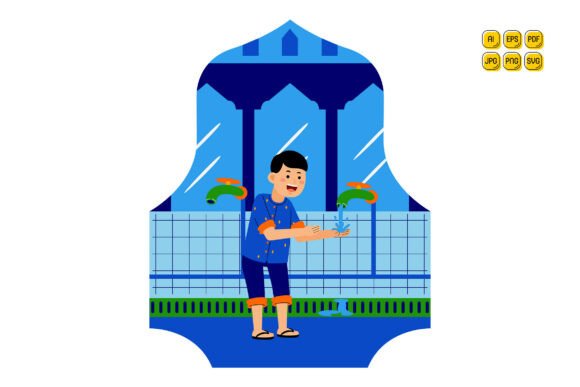
Man Ablution at Mosque: A Practical Resource for Visual Communication
Man Ablution at Mosque refers to a curated set of vector illustrations depicting the Islamic ritual of wudu—the act of physical purification performed by Muslim men before prayer—set within the architectural and spiritual context of a mosque. These illustrations are not photographs or stylized artwork; they are purpose-built, editable vector assets designed for consistent, scalable, and culturally respectful visual communication. What distinguishes this collection is its intentional balance of religious accuracy, design flexibility, and technical readiness for professional use across digital and print environments.
How It Fits Into Broader Visual Design Needs
When developing content for Islamic education platforms, mosque websites, interfaith outreach materials, or multilingual community resources, visual clarity matters. Generic human figures or abstract icons often fall short in conveying the specific postures, sequence, and setting of ablution. Man Ablution at Mosque fills that gap with 100 distinct vector illustrations—each showing variations in pose (e.g., washing hands, rinsing mouth, wiping head), perspective (front, side, three-quarter), composition (full-body, focused on hands or face), and contextual elements (mosque arches, prayer rugs, water vessels). Unlike static stock images, these are built for adaptation—not just resizing, but meaningful customization.
Compare this to alternatives: raster-based illustrations limit scalability without quality loss; clipart libraries offer limited cultural nuance and no editing control; custom illustration commissions require time, budget, and subject-matter alignment. Man Ablution at Mosque sits between those extremes—offering immediate usability with room for refinement. It’s especially valuable when consistency matters: imagine maintaining the same line weight, color palette, and stylistic tone across a series of infographics explaining the steps of wudu, a landing page for an Islamic wellness app, or printed handouts for new converts.
Technical Flexibility and Real-World Adaptability
The package includes AI, EPS, SVG, PDF, JPG, and PNG files—all at 5000 × 5000 pixels resolution. This means you’re not locked into one workflow. Designers using Adobe Illustrator can adjust layers, recolor individual shapes (e.g., changing robe color to match brand guidelines or adjusting skin tones for inclusivity), or isolate elements like water droplets or mosque domes for reuse. Developers embedding assets into web interfaces benefit from SVG’s crisp rendering at any screen size and transparency support via PNG. Print teams get high-resolution JPG and PDF versions suitable for brochures or signage.
This level of format coverage isn’t universal among illustration packs. Some vector sets omit SVG, limiting web responsiveness. Others provide only low-res PNGs, making them unsuitable for large-format banners or detailed educational posters. Man Ablution at Mosque avoids those constraints. You could, for example, extract a single figure washing hands, place it on a gradient background in a social media carousel, then later reuse that same element—unchanged—in a classroom poster alongside Arabic calligraphy, simply by adjusting colors and scaling.
Where Customization Adds Value
Each shape in every illustration is individually selectable and editable. That means you’re not just changing a global tint—you can make the water blue while keeping the tile floor warm gray, or highlight the prayer cap in gold without affecting the mosque wall behind. This granular control supports nuanced storytelling: illustrating seasonal variations (e.g., winter wudu with layered clothing), accessibility adaptations (e.g., adding visual cues for neurodiverse learners), or regional distinctions (e.g., incorporating local architectural motifs like Ottoman tiles or Southeast Asian wooden latticework).
It also enables combination work. You might take the figure from Illustration #27, the fountain detail from #63, and the dome silhouette from #89—and assemble them into a custom scene for a mosque renovation campaign. That kind of compositional freedom is rare in pre-made asset libraries and typically reserved for bespoke illustration projects.
Practical Use Cases Across Contexts
Consider how different professionals might apply this resource:
- Educators use individual frames to build step-by-step animated explainers or printable flashcards—adjusting colors to align with curriculum themes (e.g., green for “growth,” blue for “calm”).
- Website designers integrate SVG versions directly into responsive layouts, ensuring sharp visuals on mobile prayer apps or mosque donation pages without loading heavy image files.
- Nonprofit communicators adapt illustrations for multilingual outreach—swapping English labels for Urdu or Swahili text overlays while preserving visual integrity.
- Brand managers maintain visual coherence across campaigns—from Ramadan email headers to annual report infographics—by reusing the same illustrated figures with updated typography and color schemes.
None of these uses require deep illustration expertise. The flat design style minimizes shading complexity, making edits intuitive even for non-designers comfortable with basic vector tools.
Limitations and Considerations
While highly adaptable, Man Ablution at Mosque is not a substitute for contextual understanding. It provides visual building blocks—not theological guidance. Users should verify depictions against local scholarly interpretations, especially where regional practices differ (e.g., order of washing, inclusion of nose-rinsing, or footwear removal). The illustrations reflect common mainstream practice but do not cover every school of thought or cultural variation.
Also, while the set includes 100 illustrations, it focuses specifically on male ablution in mosque settings. It does not include female figures, children, or home-based wudu scenarios. If your project requires broader demographic representation or domestic contexts, you’ll need complementary assets—or plan for additional customization time.
Finally, file compatibility assumes access to standard vector-editing software. Users relying solely on free or browser-based tools may find AI or EPS files less accessible than SVG or PNG. In those cases, prioritizing SVG for web use and PNG for quick mockups is advisable.
Making an Informed Choice
Man Ablution at Mosque is most appropriate when you need reliable, respectful, and technically robust visuals for Islamic ritual content—and when you value editability over one-off decorative flair. It suits teams balancing speed, consistency, and cultural fidelity: a mosque communications team updating their website ahead of Ramadan, an edtech startup building a Quran learning platform, or a university chaplaincy creating inclusive orientation materials.
It’s less ideal if your priority is photorealism, animation-ready rigs, or broad demographic scope out of the box. And while the flat design style ensures clarity and modern appeal, it may not match brands committed to hand-drawn, textured, or 3D aesthetics without significant reworking.
Ultimately, the decision hinges on fit—not features. Ask yourself: Do we need to scale these visuals across multiple formats? Will our team customize colors, combine elements, or integrate them into larger compositions? Is accuracy in gesture and setting essential to our message? If yes, Man Ablution at Mosque offers a grounded, practical foundation—one that supports thoughtful design rather than dictating it.