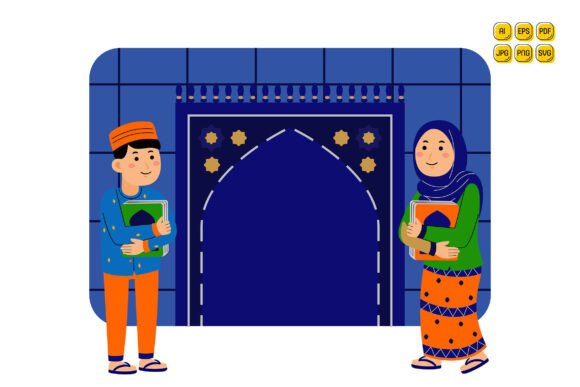
Muslim Couple with Quran
A Muslim Couple with Quran is more than a visual motif—it’s a versatile, culturally grounded design asset that supports intentionality in communication, branding, and storytelling. When thoughtfully integrated, it serves as a quiet but powerful anchor for values: faith, partnership, reverence for knowledge, and shared purpose. For professionals building digital or print assets—whether launching an Islamic education platform, designing a halal wedding service, or creating inclusive wellness content—this illustration isn’t decorative filler. It’s a strategic tool.
Why This Illustration Fits Real-World Needs
Unlike generic clipart or overused stock imagery, the Muslim Couple with Quran vector set offers precision, scalability, and contextual resonance. Its flat design style ensures clarity at any size—from a 24-pixel favicon to a 5-meter event banner—without pixelation or visual noise. More importantly, every shape is fully editable: you can adjust skin tones, garment colors, Quran cover textures, or background gradients to align with brand guidelines, seasonal campaigns, or audience-specific messaging.
This flexibility matters because consistency builds trust. A mosque-based literacy nonprofit using warm ochre and deep indigo across its website, social posts, and printed curriculum materials signals cohesion—and credibility. A freelance illustrator working with a Muslim mental health startup might recolor the couple’s attire to match their therapeutic color palette (soft sage and muted terracotta), reinforcing calm and groundedness before a single word is read.
Strategic Use Cases Across Functions
The value of the Muslim Couple with Quran emerges not from what it *is*, but how it’s *deployed*. Consider these grounded applications:
- Branding & Positioning: Small businesses targeting Muslim families—like halal meal kits, modest fashion labels, or Quran tutoring apps—use this illustration to signal cultural fluency without explanation. It avoids tokenism by centering authenticity: the couple is depicted with dignity, balance, and quiet focus—not performance.
- Learning & Education: Educators developing digital worksheets, interactive e-learning modules, or classroom posters use the editable layers to isolate elements—e.g., highlighting the Quran’s calligraphy for tajweed lessons, or animating the couple’s gestures to demonstrate mutual respect in Islamic marriage ethics.
- Customer Experience: A halal travel agency embeds a subtly resized Muslim Couple with Quran into email footers and booking confirmation screens. It doesn’t shout—it reassures. For users navigating complex logistics (prayer times, halal dining options, gender-segregated spaces), that small visual cue reinforces shared understanding and reduces cognitive load.
- Social Media & Campaigns: Rather than repurposing one static image, teams combine elements across the 100-vector library: pairing the couple silhouette with a mosque dome icon for Eid greetings, overlaying a subtle geometric pattern behind them for Ramadan content, or extracting just the open Quran for a “Quran Reflections” weekly series.
Planning Before You Edit
Before opening the AI file, ask three questions:
- What outcome do I want this illustration to support? Is it recognition? Reassurance? Engagement? Clarity? If your goal is to increase sign-ups for a Quran study group, the illustration should guide attention—not distract. That means minimal background, high contrast between figures and text, and intentional negative space around key copy.
- Who needs to recognize themselves—or feel invited—in this image? A diverse audience includes converts, multiethnic families, people with disabilities, and varying levels of religious observance. The vector set allows customization: you can adjust hijab styles, add hearing aids or mobility devices (using compatible SVG components), or modify posture to reflect inclusivity—not assumptions.
- Where will this live—and what constraints does that impose? A landing page hero section demands crisp legibility on mobile. A printable brochure requires CMYK-safe colors and bleed margins. An Instagram carousel needs vertical framing and bold focal points. The 5000 × 5000 px resolution gives room to adapt—but only if you plan for the destination first.
Risks of Unintentional Use
Even high-quality assets become liabilities when used without context. A tech startup promoting AI-powered Quran translation might place the Muslim Couple with Quran beside circuit board graphics—creating unintended dissonance between sacred tradition and cold innovation. Similarly, over-editing—adding neon effects, cartoonish expressions, or mismatched cultural motifs—can dilute meaning or alienate audiences who value reverence over novelty.
Another risk is repetition without variation. Using the same pose, color scheme, and layout across every channel flattens narrative depth. Over time, audiences stop seeing the symbolism—they see wallpaper. That’s why the 100-vector library matters: it invites iteration, not duplication. Swap the couple’s orientation (facing each other vs. side-by-side), rotate the Quran to show different surah headings, or layer in Arabic calligraphy fragments from the included EPS files to sustain visual interest while preserving coherence.
How to Build Long-Term Value
Treat the Muslim Couple with Quran as part of your visual vocabulary—not a one-time purchase. Start by auditing where human-centered, faith-aligned imagery is missing: your website’s “About Us” section, client onboarding emails, workshop handouts, or even internal team dashboards for faith-based nonprofits. Then map those gaps to specific vectors. Need warmth? Use softer color palettes and rounded line weights. Need authority? Apply bolder strokes and minimalist backgrounds.
Also consider version control. Save edited variants with clear names: couple-quran-education-blue-300dpi.png, couple-quran-wedding-gold-ai.ai. This prevents confusion during campaign rollouts and makes future updates faster. And because all files—including SVG, EPS, PDF, JPG, and PNG—are included, you’re never locked into one format or software. A blogger using Canva can drop in the PNG; a design agency using Figma imports the SVG; a print shop receives the CMYK-optimized PDF.
Final Strategic Note
Visuals don’t operate in isolation. The Muslim Couple with Quran gains strength when paired with thoughtful language, accurate representation, and consistent action. If your brand uses this illustration on a landing page promising “Quran-based parenting guidance,” ensure the content delivers actionable frameworks—not vague inspiration. If it appears beside testimonials from Muslim educators, verify those voices are authentically represented, not curated for aesthetic harmony alone.
In short: the illustration is a lever—not the load. Its power multiplies when aligned with clear goals, respectful execution, and ongoing evaluation. You’re not just buying 100 vectors. You’re investing in agility: the ability to communicate with clarity, adapt with integrity, and grow with intention.