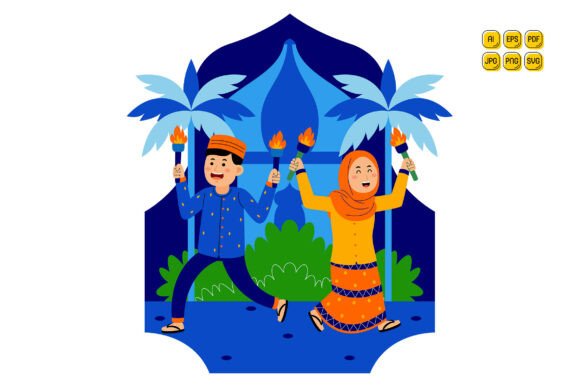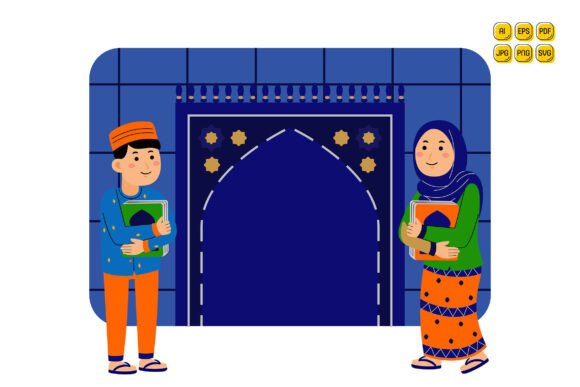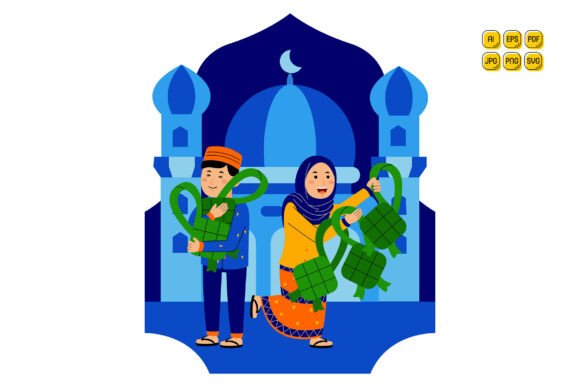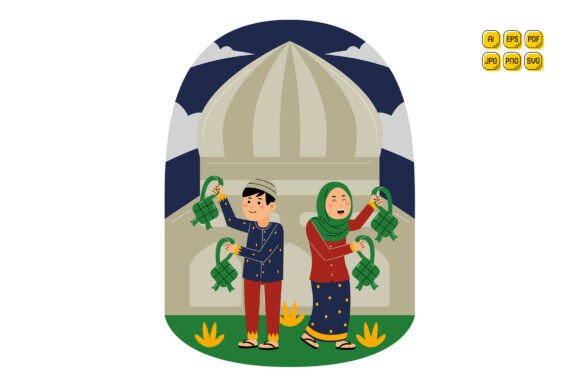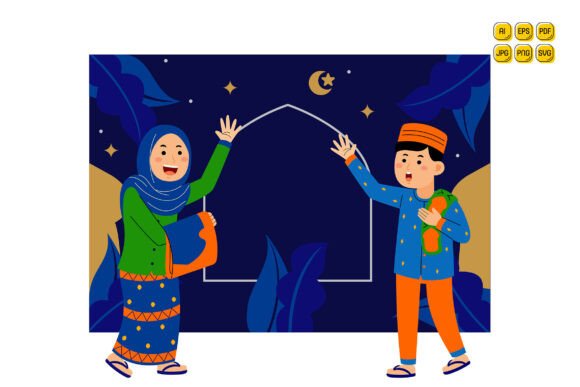
Muslim Couple Celebrating Ramadan
Ramadan is the ninth month of the Islamic lunar calendar, observed globally by Muslims through fasting, prayer, reflection, and community. A Muslim Couple Celebrating Ramadan represents a meaningful cultural and spiritual motif—depicting shared devotion, mutual support, and quiet reverence during this sacred time. In visual design, such illustrations often feature two individuals in modest, culturally resonant attire, seated or standing near symbolic elements: a crescent moon, lanterns (fanous), dates, an open Quran, or a softly lit iftar table. These visuals are not religious icons but respectful, inclusive representations intended for educational, commemorative, or design-oriented use.
Designers, marketers, educators, and content creators may seek a Muslim Couple Celebrating Ramadan illustration for several practical reasons. It can support inclusive seasonal campaigns—especially around Ramadan greetings, interfaith outreach, or diversity-focused communications. Schools and NGOs might use it in multicultural curriculum materials. Businesses operating in Muslim-majority markets—or those serving diverse communities—may incorporate it into website banners, social media posts, or printed resources to signal cultural awareness and respect. Unlike generic holiday imagery, this motif offers specificity without stereotyping, provided it is rendered thoughtfully and contextually.
The value of a high-quality vector package—such as one offering 100 editable Muslim Couple Celebrating Ramadan illustrations—lies in its flexibility. Vector formats (AI, EPS, SVG, PDF) allow infinite scaling without loss of clarity, making them suitable for everything from mobile app icons to large-format print. The inclusion of both JPG (for broad compatibility) and PNG (with transparent background) ensures adaptability across digital platforms. At 5000 × 5000 pixels, the raster files meet professional print and web standards. Crucially, each shape is individually layered and color-coded in Illustrator, enabling users to adjust hues, swap elements, or combine motifs—say, merging a couple silhouette with a mosque outline or integrating Arabic calligraphy—without needing advanced illustration skills.
However, users should consider several practical factors before adopting such assets. First, cultural sensitivity remains paramount. While the illustrations are stylized and neutral, their application must align with context and audience expectations. For example, using a Muslim Couple Celebrating Ramadan image in a commercial food promotion may be appropriate; deploying it in a religious instruction setting without consultation could risk misrepresentation. Second, technical readiness matters: editing AI or EPS files requires Adobe Illustrator or compatible software. Users unfamiliar with vector layers may need a brief learning curve to unlock full customization—though basic recoloring or resizing is straightforward even for beginners.
Another consideration is stylistic consistency. The flat design aesthetic—clean lines, minimal gradients, uncluttered composition—works well for modern digital interfaces and scalable branding. But it may not suit projects requiring photorealism, hand-drawn texture, or historical accuracy. If a campaign calls for regional specificity—such as South Asian, Arab, or Southeast Asian visual cues—the base illustrations offer adaptable silhouettes and garments, yet users should verify whether subtle details (e.g., headscarf styles, fabric patterns) match intended representation. Customization helps, but informed judgment remains essential.
A Muslim Couple Celebrating Ramadan vector set is especially well-suited for teams managing recurring seasonal content. Marketing departments preparing annual Ramadan campaigns benefit from having reusable, on-brand assets that reduce reliance on stock photos or custom commissions. Similarly, educators building digital lesson plans or non-profits designing multilingual outreach materials gain efficiency and visual coherence. The ability to quickly generate variations—light/dark mode versions, gender-inclusive pairings, or alternate settings (home, mosque courtyard, virtual iftar)—supports accessibility and inclusivity goals without added production time.
That said, alternatives may be preferable in certain scenarios. For instance, organizations prioritizing authenticity over scalability might commission original artwork from Muslim illustrators—ensuring lived experience informs visual nuance and avoiding unintentional homogenization. Similarly, projects with strict brand guidelines tied to proprietary color systems or iconography may find pre-made vectors require more adaptation than anticipated. And while the package includes 100 illustrations, users with highly specialized needs—such as animated SVGs, 3D renders, or culturally specific regional variants—may need supplemental resources.
Decision-making hinges on balancing scope, control, and intent. Ask: Is the goal to produce timely, respectful, and visually consistent Ramadan-related material across multiple channels? Then a versatile, editable vector collection offers strong utility. Is the priority deep cultural resonance or narrative storytelling? Then collaborative creation with community input may yield richer outcomes. Does the team have access to design tools and basic vector literacy? If not, simpler PNG/JPG usage still delivers value—though with less long-term adaptability.
Also consider longevity. Vector files retain relevance across platform updates and resolution shifts—unlike raster-only assets that may pixelate on new devices. The inclusion of SVG supports responsive web design, while PDF ensures reliable preview and print proofing. This future-proofs content without demanding constant reformatting. Yet file management matters: organizing layered AI files, maintaining naming conventions, and documenting color palettes will maximize reuse across teams and timelines.
Finally, evaluate alignment with broader communication goals. A Muslim Couple Celebrating Ramadan illustration gains meaning through context—not isolation. Paired with accurate captions, respectful language, and thoughtful placement, it reinforces dignity and recognition. Used generically or without supporting narrative, it risks becoming decorative rather than meaningful. Therefore, the asset’s strength lies not just in technical quality, but in how intentionally it serves the message and audience.
In summary, a professionally crafted, editable vector package centered on Muslim Couple Celebrating Ramadan meets tangible design needs: scalability, format versatility, and ease of customization. Its usefulness emerges most clearly for practitioners who value efficiency without sacrificing cultural appropriateness—and who understand that visual tools, however well-made, function best when guided by purpose, awareness, and care.