Cartoon Hand Gesture Set Illustration: A Practical Guide for Designers and Communicators
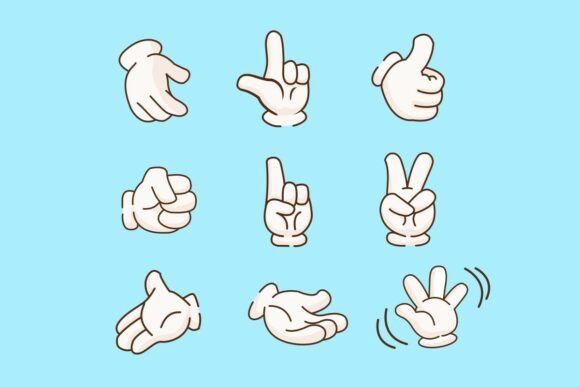
A Cartoon Hand Gesture Set Illustration is a curated collection of vector-based hand poses—like pointing, thumbs up, waving, clapping, high-fiving, and open-palm gestures—rendered in a clean, expressive, and intentionally simplified cartoon style. Unlike photorealistic or anatomically precise hand illustrations, this type of set prioritizes clarity, emotional resonance, and visual consistency across poses. Each gesture is built with smooth curves, balanced proportions, and intentional negative space, making it legible at small sizes and adaptable across contexts.
What Sets This Style Apart From Other Hand Visuals
Not all hand illustrations serve the same purpose. Photographic hand images convey realism but lack flexibility in tone or scalability. Line-drawn or minimalist icons often sacrifice expressiveness for simplicity. In contrast, the Cartoon Hand Gesture Set Illustration occupies a deliberate middle ground: it’s stylized enough to feel friendly and approachable, yet detailed enough to communicate specific intent—whether encouragement, direction, celebration, or invitation.
The use of consistent stroke weight, rounded terminals, and subtle shape variation (e.g., slightly exaggerated finger curvature for emphasis) helps maintain visual cohesion across the full set. That uniformity matters when building a library of UI elements, social media assets, or educational visuals where recognition and rhythm support comprehension—not just decoration.
How It Compares With Alternative Approaches
Designers evaluating hand visuals typically weigh several options: custom-drawn illustrations, stock photo collections, icon fonts, generative AI outputs, or open-source SVG libraries. Each has tradeoffs:
- Custom illustration offers full control over style and nuance but requires time, skill, and budget—especially when scaling across dozens of gestures.
- Stock photography delivers realism and diversity but struggles with consistency, background removal, licensing restrictions, and emotional tone alignment across platforms.
- Icon fonts or generic SVG sets are efficient and scalable but often lack gesture specificity (e.g., “waving hello” vs. “waving goodbye”) or expressive subtlety (e.g., a relaxed vs. enthusiastic thumbs-up).
- AI-generated hand art can produce novelty quickly but frequently misrepresents anatomy (extra fingers, warped joints), lacks stylistic continuity, and raises usage rights questions—particularly for commercial deployment.
The Cartoon Hand Gesture Set Illustration avoids many of these pitfalls by delivering a pre-vetted, production-ready collection. Its vector foundation (SVG, EPS) ensures crisp rendering at any size, while included PNG files offer immediate compatibility with tools that don’t support vector imports. The design language is neither overly childish nor sterile—it reads as warm and inclusive without leaning into niche aesthetics like retro pixel art or hyper-realism.
Practical Strengths—and Where It Has Limits
Strengths emerge most clearly in projects where tone, scalability, and speed matter. For example:
- An educator creating printable classroom posters might use the “raising hand” and “thinking” gestures to label behavior expectations—relying on instant recognition and print-safe resolution.
- A SaaS team building onboarding tooltips could embed the “pointing” and “tap here” gestures directly into UI mockups, maintaining brand voice without needing custom asset creation.
- A nonprofit designing an accessibility guide might pair the “listening,” “speaking,” and “pause” gestures with plain-language text—leveraging visual metaphor to reinforce meaning across literacy levels.
However, limitations exist. Because the set follows a unified cartoon aesthetic, it may not suit brands committed to ultra-minimalist, monoline, or hand-drawn sketch styles. It also doesn’t include animated versions—so motion-based interfaces would require additional development. And while the gestures cover common interactions (waving, clapping, OK sign), highly contextual or culturally specific poses (e.g., regional greetings, sign language symbols) fall outside its scope.
Fitting the Set Into Real-World Workflows
Compatibility extends beyond file formats. Because the Cartoon Hand Gesture Set Illustration includes SVG, EPS, and PNG, it integrates smoothly into diverse environments:
- Web and app design: SVG files embed cleanly in HTML/CSS and scale responsively without quality loss—ideal for interactive states or dynamic infographics.
- Print materials: EPS and high-res PNGs ensure fidelity in brochures, posters, and presentation decks—even at large physical sizes.
- Social media and marketing: Pre-sized PNG variants simplify rapid content creation for Stories, carousels, or email headers where visual consistency supports campaign recognition.
- Educational and internal comms: Teachers, HR teams, and trainers benefit from ready-to-use visuals that reduce cognitive load—especially when explaining processes or soft skills.
Importantly, no specialized software is required to begin using the set. Designers working in Figma, Adobe Illustrator, or even Canva can import and recolor elements without breaking vectors. Non-designers using PowerPoint or Google Slides can drop in PNGs and resize with confidence.
When This Set Fits—and When to Look Elsewhere
This Cartoon Hand Gesture Set Illustration is especially appropriate when you need:
- A cohesive, expressive visual vocabulary across multiple touchpoints;
- Quick implementation without sacrificing tone or clarity;
- Scalability across digital and print outputs;
- Accessibility-aware visuals that support comprehension through universal gesture cues.
It’s less suitable if your project demands:
- Photographic authenticity (e.g., medical training materials showing proper hand hygiene technique);
- Highly branded, bespoke illustration that must match exact color systems or character design guidelines;
- Dynamic or interactive gestures requiring frame-by-frame animation;
- Legal or regulatory compliance where gestures must follow standardized symbols (e.g., ISO safety signage).
In those cases, supplementing with custom illustration, licensed photography, or domain-specific symbol libraries may be more effective—even if it adds time or cost.
Making a Grounded Decision
Choosing hand visuals isn’t about finding the “best” option overall—it’s about matching the tool to the task, audience, and constraints. The Cartoon Hand Gesture Set Illustration excels where warmth, clarity, and consistency converge: in digital learning, inclusive communication, product onboarding, and brand-aligned social content. It saves time without diluting intent.
But it’s worth pausing before committing: review your current assets. Do you already have a hand illustration system in place? Does your audience respond better to realism or abstraction? Are gestures used decoratively—or do they carry functional meaning (e.g., indicating steps in a process)? Answering those questions honestly helps determine whether this set fills a real gap—or simply adds redundancy.
Ultimately, the value lies not in the gestures themselves, but in how reliably they help your message land. When selected thoughtfully, the Cartoon Hand Gesture Set Illustration becomes less of a decorative add-on and more of a quiet, effective collaborator in visual communication.