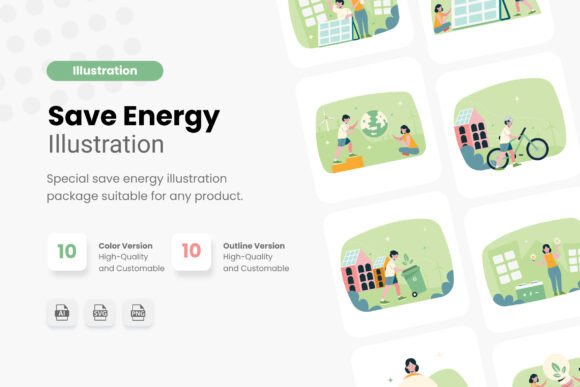
Save Energy Illustration
Visual communication shapes how people understand complex ideas—especially when it comes to sustainability. The Save Energy Illustration set bridges that gap: a cohesive, thoughtfully designed collection of vector illustrations focused squarely on energy awareness, electricity conservation, and everyday eco-conscious actions. What makes it stand out isn’t just its clean, modern aesthetic—it’s how purposefully each image supports real-world use. No vague green icons or overused lightbulb clichés. Instead, you’ll find balanced compositions showing smart thermostat use, solar panel installation, unplugging idle devices, cycling instead of driving, and families choosing LED lighting—all rendered with clarity, warmth, and visual consistency.
Why These Illustrations Work Where Others Fall Short
Many illustration sets sacrifice meaning for style—or vice versa. Save Energy Illustration avoids both traps. Each of the 10 scenes is built around an actionable concept, not just decoration. That intentionality shows in the details: subtle gradients suggest daylight savings, soft shadows ground objects in space, and consistent line weight keeps focus where it belongs—on behavior, not ornamentation. Because they’re fully editable vector files (AI and SVG), designers can adjust colors to match brand palettes, resize without pixelation, or isolate elements for layered infographics. And with transparent-background PNGs included, there’s no extra work needed for web banners, social posts, or presentation slides.
Creative Applications Across Roles and Platforms
Different users need different things—and this set delivers flexibility without compromise.
- Designers & marketers can build cohesive campaign assets—think email headers, landing page visuals, or animated social carousels—using the same visual language across touchpoints. Try pairing the “unplugging devices” illustration with a short tip (“Phantom load accounts for up to 10% of home energy use”) in a newsletter graphic.
- Educators and nonprofits benefit from the clarity and narrative strength. Use the “school rooftop solar” scene in a classroom handout, then adapt the same vector into a simplified version for younger students—just recolor and simplify paths in Illustrator.
- Bloggers and content creators gain ready-made visuals that reinforce written advice. A post about reducing summer AC use pairs naturally with the “shaded windows + fan” illustration—no stock photo licensing headaches, no mismatched styles.
- Small business owners (like eco-friendly cafes or hardware stores) can integrate these into signage, receipts, or loyalty program graphics—adding authenticity to their sustainability messaging without hiring an illustrator.
Keeping Your Projects Clear and Audience-Focused
Great visuals don’t shout—they guide. When using Save Energy Illustration, prioritize context over decoration. Ask: *What action do I want viewers to consider? What barrier might they face? How does this image lower that barrier?* For example, the “energy-efficient laundry” illustration shows cold-water washing, full loads, and air-drying—not just a washing machine. That specificity builds trust. It signals you understand real habits, not just ideals.
Consistency matters too. If you’re building a multi-slide presentation, use the same base color scheme across all selected illustrations—even if you tweak accent hues. That subtle repetition reinforces your message before a single word is read. And when adapting for print (like posters or workshop handouts), lean into the high-res PNGs and test contrast—especially for audiences with low vision. The clean linework and ample negative space in this set already support accessibility; a few intentional tweaks extend that further.
Realistic Project Ideas You Can Start This Week
You don’t need a big budget or long timeline to make meaningful use of these illustrations. Here are three grounded, executable ideas:
- Local utility outreach toolkit: Combine 3–4 illustrations with short, localized tips (“In [City], heating accounts for 52% of household energy use—try lowering your thermostat by 2° in winter”) to create downloadable PDF guides for community centers or libraries.
- Classroom energy audit worksheet: Use the “home energy checklist” illustration as a base. Add editable text boxes in Illustrator so students can write in their own observations—then print or share digitally.
- Small business Instagram series: Post one illustration per week with a 1-sentence action tip and a real result (“Switching to LED bulbs cut our café’s lighting costs by 75% in 3 months”). Tag local suppliers or rebates where relevant.
Design Integrity Meets Practical Flexibility
These aren’t generic clipart replacements. Every illustration in the Save Energy Illustration set was created as part of a unified system—same stroke logic, shared perspective rules, harmonized color temperature. That means when you mix and match, nothing clashes. But because they’re vector-based and fully editable, you retain full creative control. Need to flip the “biking commute” scene for right-to-left language layouts? Done. Want to add your logo subtly into the corner of the “smart power strip” illustration? Easy. The transparency of the PNGs also means you can layer them over photos, gradients, or textures—ideal for modern web design where depth and dimension matter.
And because all files are exclusively available on Creative Fabrica—and completely unique—you’re not competing with competitors using identical visuals. That originality strengthens your brand’s credibility, especially in spaces where authenticity around sustainability is increasingly scrutinized.
A Resource Built for Doing, Not Just Displaying
The best creative assets don’t sit unused in a folder. They get opened, adjusted, combined, printed, shared, and reused—with intention. Save Energy Illustration was made for that rhythm: practical enough for tight deadlines, expressive enough to carry meaning, and flexible enough to grow with your projects. Whether you’re designing a city-wide energy challenge, updating a school curriculum, or launching a new eco-product line, these illustrations offer more than visual polish—they offer a shared visual vocabulary for action.
Start small. Pick one illustration that matches your next immediate need. Open the AI file. Adjust a color. Drop it into your layout. See how much faster and clearer your message lands—because sometimes, the most powerful step toward saving energy begins with choosing the right image.