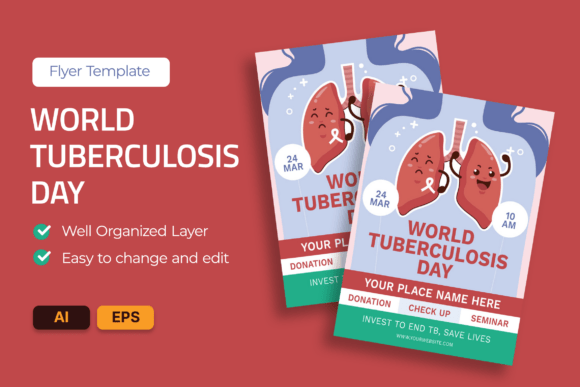
World Tuberculosis Day Flyer Template: A Strategic Tool for Impact-Driven Health Communication
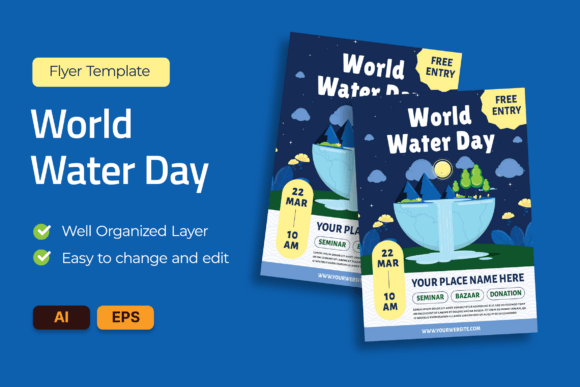
Public health outreach isn’t just about delivering information—it’s about triggering action, shifting perception, and sustaining awareness long after the campaign ends. The World Tuberculosis Day Flyer Template is more than a design file; it’s a purpose-built communication asset engineered for clarity, urgency, and adaptability. Designed with respiratory health at its core—vivid red tones, anatomically grounded lung motifs, layered infographics, and prevention-first typography—it meets audiences where they are: visually engaged, contextually aware, and emotionally responsive.
Why This Template Fits Real-World Public Health Workflows
For hospitals, NGOs, clinics, and government health departments, time and consistency are non-negotiable. You need materials that align with evidence-based messaging while accommodating local language, regional data, and cultural nuance—all without redesigning from scratch. The World Tuberculosis Day Flyer Template delivers that balance. Its A4 CMYK 300 DPI format with bleed ensures print-ready output across diverse printing partners. Its organized layer structure in Illustrator (AI) and EPS means your team can isolate text blocks, swap icons, adjust color values, or reposition visual hierarchy—without breaking alignment or resolution.
Crucially, it uses only free, widely available fonts. No licensing friction. No last-minute font substitution errors. That’s not just convenience—it’s operational reliability. When your campaign launches during a seasonal TB surge or coincides with national health observances, having a template that supports rapid iteration—not rework—is a strategic advantage.
When to Reach for This Template (and When to Pause)
Use the World Tuberculosis Day Flyer Template when your goal is clear, audience-specific, and time-bound: launching a community screening drive in March; supporting World TB Day events on March 24; reinforcing respiratory hygiene in schools or workplaces; or training frontline health workers on symptom recognition and referral pathways. It works best when paired with locally validated facts—not generic statistics—and when visuals serve function over decoration.
But don’t reach for it reflexively. If your objective is deep behavioral change—like improving treatment adherence among vulnerable populations—the flyer alone won’t suffice. In those cases, the template is most powerful as one component of a multi-channel strategy: a physical handout that complements SMS reminders, peer-led discussions, or clinic-based counseling. Using it without anchoring it to a broader plan risks reducing complex public health work to a one-time visual impression.
Strategic Planning Tips Before Customization
- Define your primary action ask first. Is it “Get tested today”? “Know the symptoms”? “Support TB-free communities”? Let that dictate headline hierarchy—not aesthetics.
- Localize before you decorate. Replace stock image placeholders with real photos of local health workers or community members (with consent), and translate key messages using culturally resonant terms—not literal translations.
- Test readability at scale. Print a draft at actual size and hold it at arm’s length. Can someone scan it in under 8 seconds and grasp the core message? If not, simplify typography, reduce text density, or reinforce visual cues like iconography or directional arrows.
- Map it to your distribution channel. A flyer handed out at a rural health camp needs bolder type and fewer paragraphs than one displayed in a hospital waiting room. Adjust spacing, contrast, and call-to-action prominence accordingly.
How It Strengthens Branding—Without Saying Your Name
Your organization’s credibility doesn’t live in a logo placement—it lives in consistency of voice, accuracy of content, and respect for audience intelligence. The World Tuberculosis Day Flyer Template supports this by offering a structured visual grammar: red for urgency and blood oxygenation, lung silhouettes for anatomical grounding, clean sans-serif type for legibility, and intentional white space to avoid cognitive overload. When your team applies these elements thoughtfully—pairing them with verified data from WHO, CDC, or national TB programs—you reinforce trust through coherence, not repetition.
This matters especially for smaller NGOs or regional clinics competing for attention alongside larger institutions. A well-executed flyer signals professionalism, preparedness, and alignment with global standards—even without a massive communications budget.
Risks of Using the Template Without Intention
The biggest risk isn’t technical—it’s strategic drift. Because the template is editable and ready-to-use, it’s tempting to treat customization as a checkbox task: “swap logo, insert date, print.” But that approach often leads to flyers that look polished but fail to move the needle. You might end up with:
- Infographics that illustrate transmission pathways but omit local risk factors (e.g., overcrowded housing, diabetes prevalence, or air pollution levels);
- Prevention tips that assume universal access to masks, ventilation, or healthcare—ignoring structural barriers;
- Typography choices that prioritize style over accessibility (e.g., light-weight fonts that fade on low-quality paper or in dim lighting).
These aren’t design flaws—they’re misalignments between tool and context. The World Tuberculosis Day Flyer Template doesn’t replace local insight. It amplifies it—if used deliberately.
Practical Examples of Intentional Use
A district health office in Maharashtra used the template to launch a “TB Symptom Spotter” campaign targeting ASHA workers. They replaced generic lung illustrations with annotated diagrams showing early vs. late-stage cough patterns, added QR codes linking to vernacular audio guides, and printed on recycled paper with seed-embedded corners—turning disposal into engagement. Result: 37% increase in referrals from community health volunteers in Q1.
An urban NGO repurposed the layout for a youth-focused initiative, swapping clinical imagery for illustrated characters wearing masks in classrooms and buses, and embedding a simple “3-Question Self-Check” (cough >2 weeks? Fever? Weight loss?) directly into the main visual flow. They distributed digitally via WhatsApp groups first—testing comprehension before printing. Feedback shaped version two, which included sign language icons for deaf participants.
Both examples share a pattern: the World Tuberculosis Day Flyer Template served as infrastructure—not content. The value came from what was layered onto it: local knowledge, participatory feedback, and outcome-oriented design decisions.
Long-Term Value Beyond March 24
TB doesn’t observe calendar dates—and neither should your communication strategy. The World Tuberculosis Day Flyer Template is built for reuse. With minor adjustments, it becomes a respiratory health primer for flu season, a COPD awareness tool, or a post-pandemic lung wellness resource. Its modular layers support iterative updates: swap TB incidence stats for asthma prevalence data; replace “DOTS” with “self-administered therapy” guidance; update contact numbers to reflect new telehealth lines.
That longevity pays off operationally. One health education coordinator reported cutting average flyer production time from 14 hours to under 3—freeing capacity for community listening sessions and impact tracking instead of layout tweaks. That’s not just efficiency. It’s reallocating human capital toward higher-leverage activities.
Making Better Decisions—Not Just Better Flyers
Choosing to use the World Tuberculosis Day Flyer Template is less about selecting a file and more about committing to disciplined communication. It asks you to clarify goals before opening Illustrator. To consult frontline staff before finalizing symptom lists. To test translations with native speakers—not just bilingual colleagues. To ask, “What does this flyer enable people to *do*—not just know?”
That mindset transfers. Once your team develops fluency in adapting templates with intention—grounded in audience insight, outcome clarity, and ethical responsibility—you build transferable skills: sharper messaging discipline, faster cross-functional alignment, and greater confidence in scaling proven approaches. The template doesn’t create impact. It helps you deliver it—consistently, respectfully, and effectively.